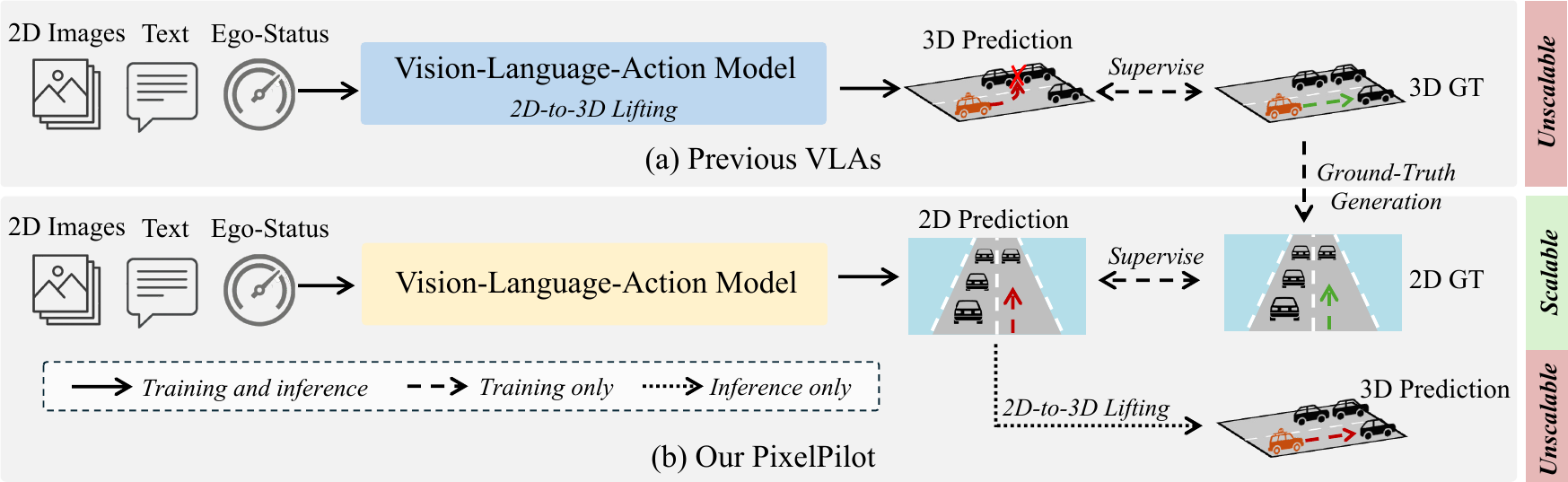
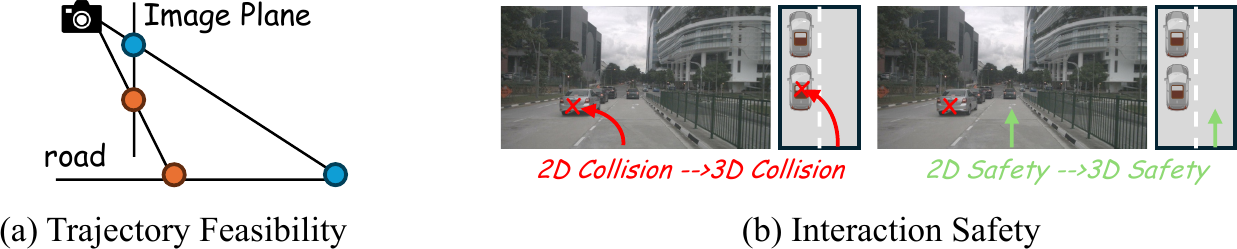
Vision-Language-Action Models leverage the reasoning capabilities of VLMs, but existing driving VLAs typically predict 3D trajectories directly from 2D images. This couples learning with camera parameters, limiting data scalability across heterogeneous driving datasets and encouraging trivial ego-status shortcuts.
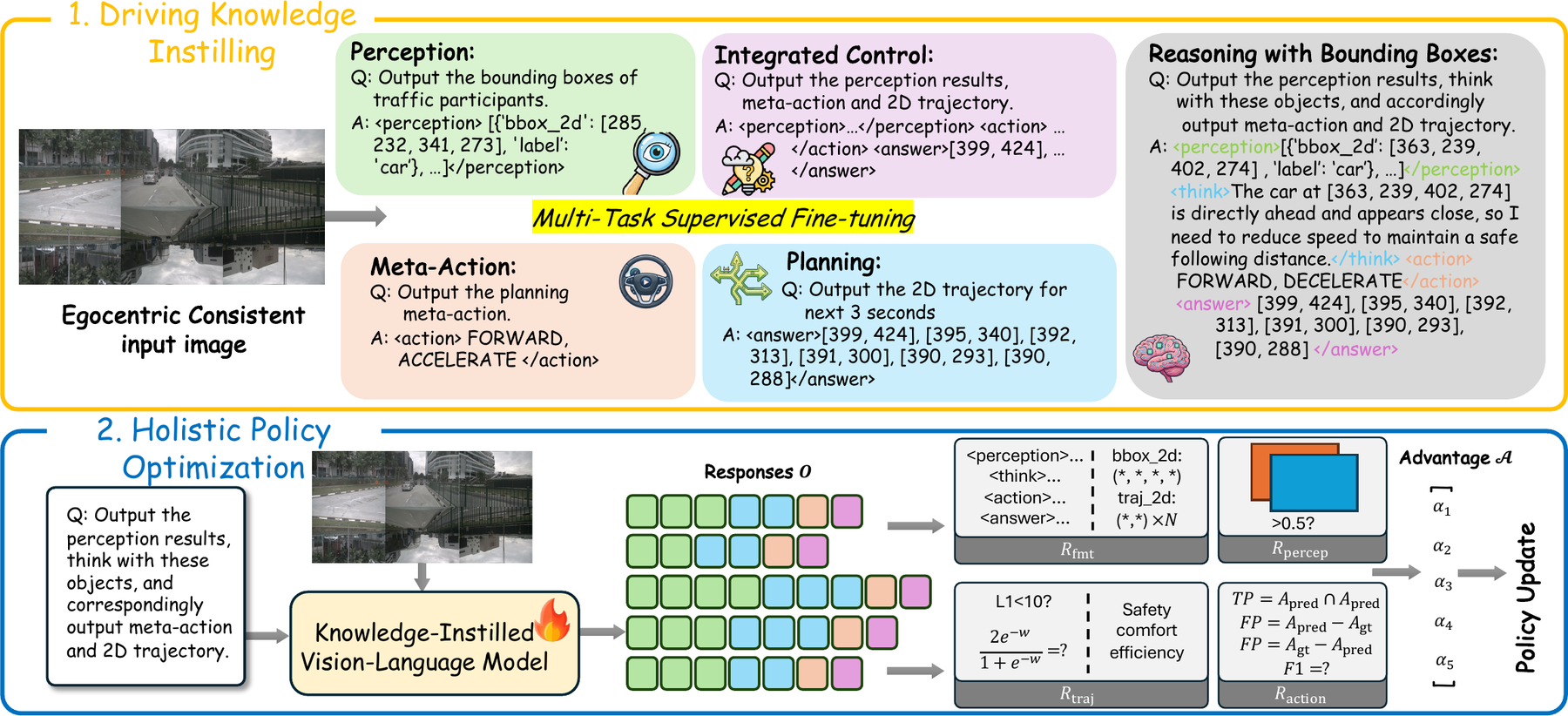
PixelPilot introduces a decoupled planning and lifting paradigm. It reformulates scene understanding and trajectory prediction as sensor-agnostic 2D-to-2D tasks in the image plane, then deterministically lifts planned 2D trajectories to 3D only during inference. A knowledge-instilled policy learning strategy further applies dense intermediate rewards through GRPO, encouraging a causal chain from perception to reasoning, meta-action, and final spatial planning.
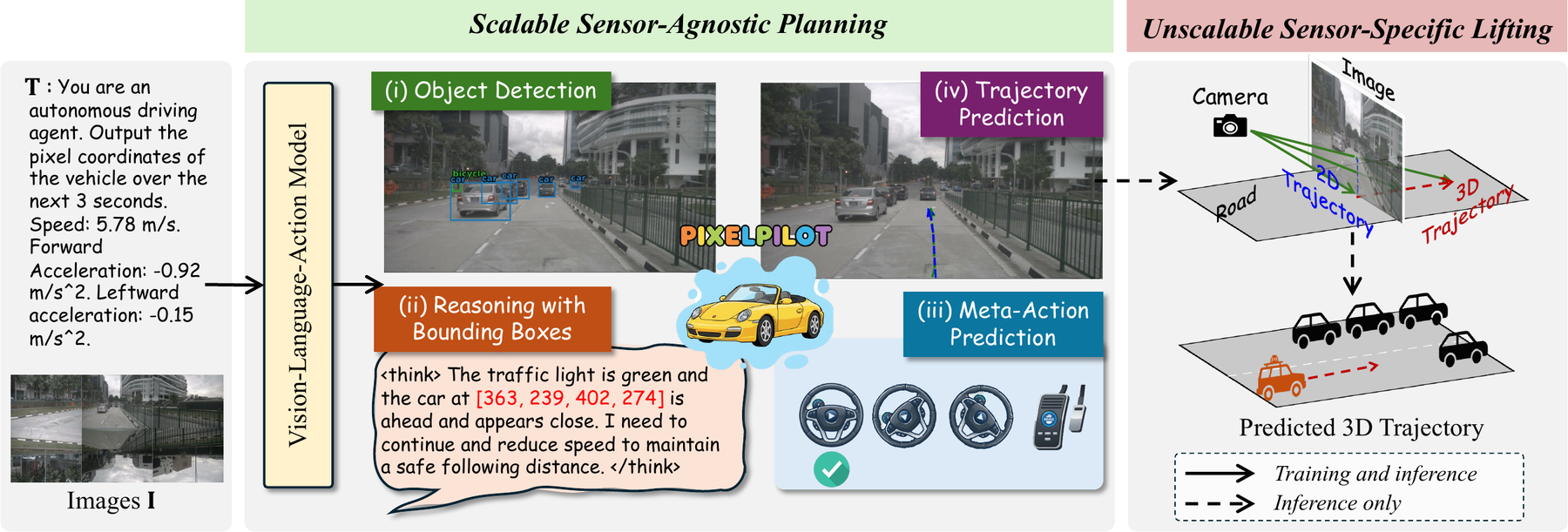
PixelPilot keeps the learnable VLA policy in the image plane and moves sensor-specific geometry into a deterministic inference-time lifting step.
Perception, visual reasoning, meta-action prediction, and waypoint planning are optimized as 2D image-space tasks.
Predicted 2D trajectories are projected into 3D with the target vehicle's camera parameters during inference.
Reasoning with 2D bounding boxes anchors the final plan to visible agents and scene structure.
PixelPilot first learns foundational driving behavior through multi-task SFT, then refines the policy with GRPO using dense rewards on verifiable intermediate outputs.
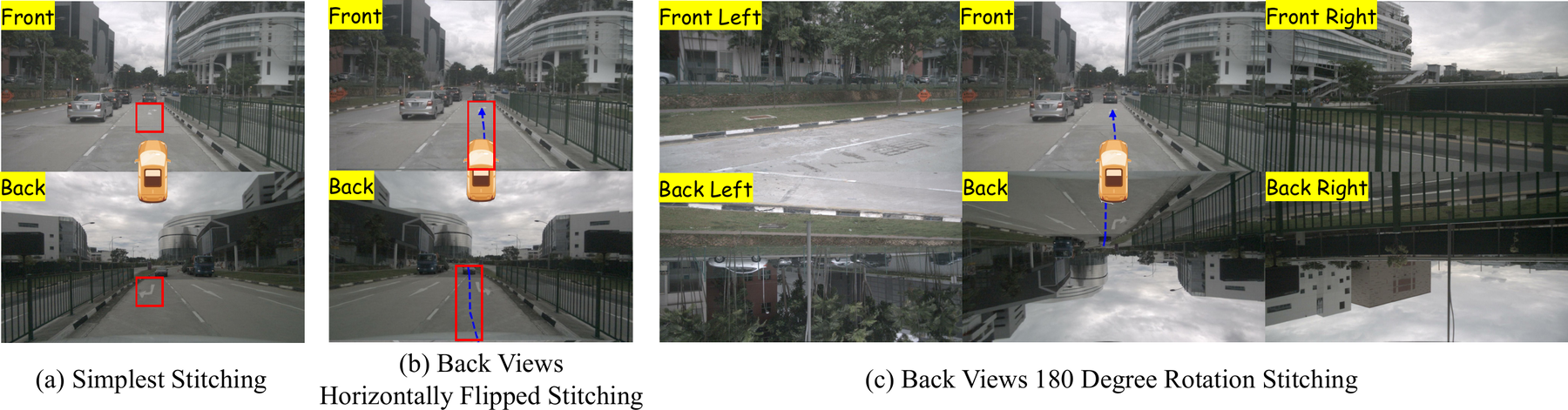
PixelPilot achieves state-of-the-art open-loop planning performance on nuScenes and the best overall driving score among compared methods on Bench2Drive.
| Method | nuScenes Avg. L2 ↓ | Avg. Collision ↓ | Avg. Intersection ↓ | Bench2Drive Score ↑ | Success Rate ↑ |
|---|---|---|---|---|---|
| OmniDrive | 0.33 | 0.30 | 3.00 | - | - |
| OpenDriveVLA | 0.33 | 0.10 | - | - | - |
| AutoVLA | 0.40 | 0.20 | - | 78.84 | 57.73% |
| Orion | - | - | - | 77.74 | 54.62% |
| PixelPilot | 0.30 | 0.25 | 1.77 | 79.14 | 58.87% |
Open-loop metrics are reported on nuScenes. Closed-loop metrics are reported on Bench2Drive in CARLA.
| Method | Ego-Status | Images | Avg. L2 ↓ |
|---|---|---|---|
| OmniDrive | No | Yes | 1.98 |
| OmniDrive | Yes | No | 0.36 |
| Imprompt-VLA | No | Yes | 2.39 |
| Imprompt-VLA | Yes | No | 0.36 |
| PixelPilot | No | Yes | 0.71 |
| PixelPilot | Yes | No | 0.90 |
Unlike direct 3D prediction VLAs, PixelPilot degrades less when ego-status is removed than when images are removed, indicating stronger reliance on visual cues.
The demo video shows PixelPilot's image-space reasoning and trajectory planning behavior in autonomous driving scenes.
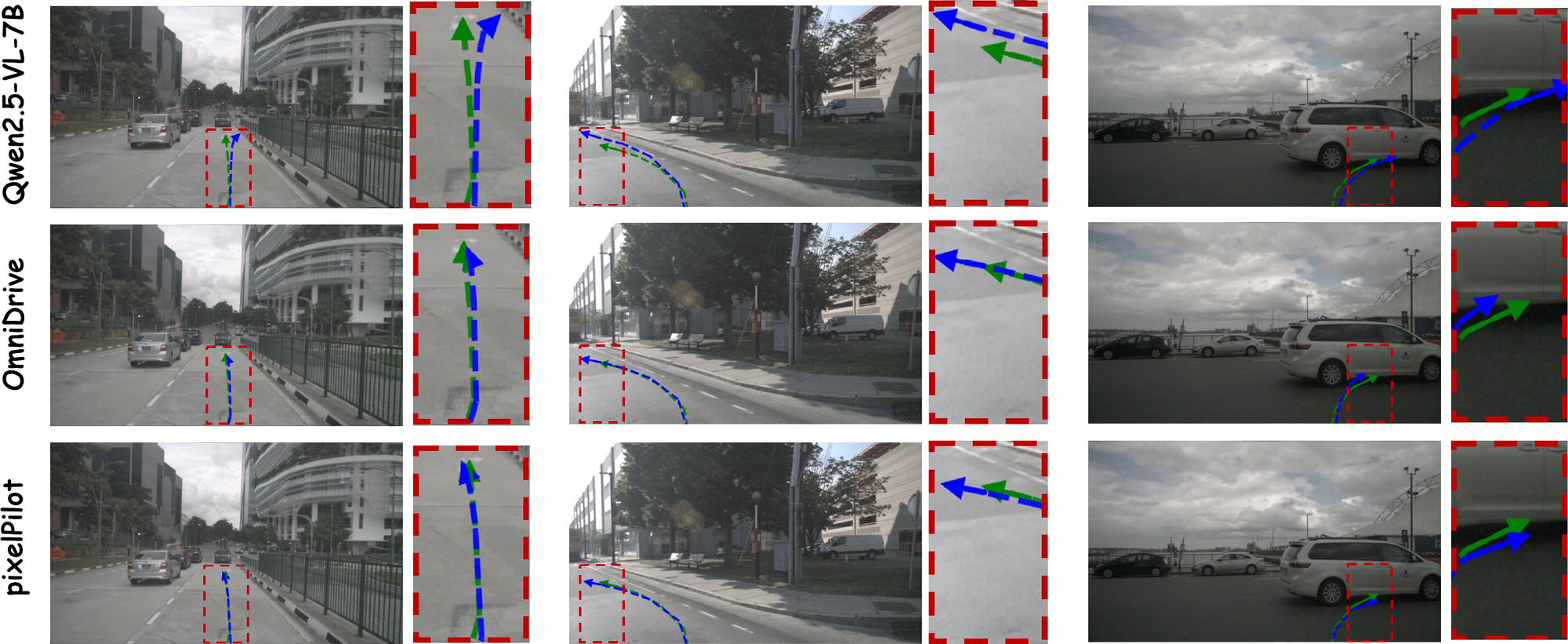
PixelPilot produces reliable 2D trajectories that closely align with ground truth across turning and interaction-heavy scenes.
@inproceedings{tang2026pixelpilot,
  title     = {PixelPilot: Scalable Vision-Language-Action Models for End-to-End Autonomous Driving},
  author    = {Tang, Pin and Wang, Guoqing and Ren, Xiangxuan and Wang, Zhongdao and Zhao, Guodongfang and Feng, Bailan and Ma, Chao},
  booktitle = {European Conference on Computer Vision (ECCV)},
  year      = {2026}
}